

Global Targeted Oncology Biologics Market to Reach USD 186.9 Billion by 2036, Driven by Precision Medicine
targeted oncology biologics market
DE, UNITED STATES, April 3, 2026 /EINPresswire.com/ --
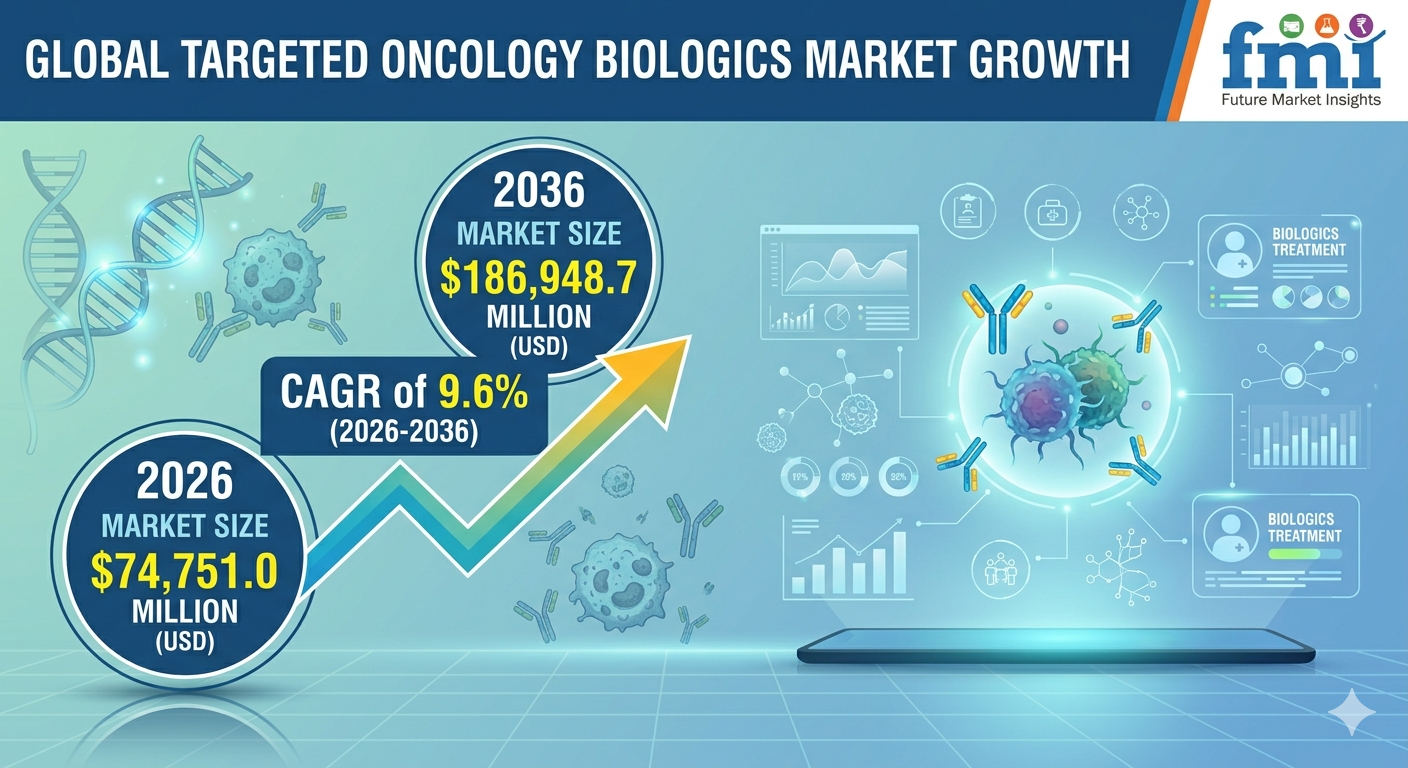
The global targeted oncology biologics market is poised for robust expansion, projected to grow from USD 74,751.0 million in 2026 to USD 186,948.7 million by 2036, registering a CAGR of 9.6% over the forecast period, according to Future Market Insights (FMI). This growth is driven by the structural shift in oncology care toward molecularly defined treatment pathways, where therapies are tailored based on tumor biology rather than conventional cytotoxic approaches.
The market is witnessing increased integration of targeted biologics across first-line, maintenance, and relapse treatment settings. As genomic profiling becomes standard practice, the identification of actionable biomarkers is expanding the eligible patient population and enabling more precise and effective treatment strategies.
Targeted Oncology Biologics Market Quick Stats Snapshot
2026 Market Value: USD 74,751.0 Million
2036 Forecast Value: USD 186,948.7 Million
CAGR (2026–2036): 9.6%
Leading Product Category: Monoclonal antibodies (46.0% share)
Top Application Segment: Breast cancer (28.0% share)
Leading End User: Hospital oncology centers (64.0% share)
Fastest-Growing Countries: India, China, Brazil, USA, UK
Market Momentum: Precision Oncology and Extended Treatment Duration Driving Growth
Demand for targeted oncology biologics is rising as oncologists increasingly adopt therapies that act on specific molecular pathways involved in tumor growth and progression. These therapies—including monoclonal antibodies and engineered proteins—are used in biomarker-defined patient populations, often administered continuously until disease progression, resulting in prolonged treatment duration and higher per-patient value.
Hospital oncology centers dominate market demand due to their role in infusion-based delivery, diagnostic integration, and treatment sequencing. Growth is supported by combination therapy strategies, expanded indication labeling, and improved survival outcomes across multiple cancer types.
Market Value Analysis
Market expansion is shaped by patient stratification and increasing protocol complexity rather than replacement of traditional therapies. Broader access to genomic testing is increasing treatment eligibility, while therapy sequencing and switching among biologics extend overall lifetime treatment value.
Despite biosimilar entry improving accessibility, overall market value remains strong due to rising treatment volumes and longer therapy persistence. However, high manufacturing complexity, cold-chain requirements, and reimbursement scrutiny continue to moderate unrestricted adoption, particularly in cost-sensitive healthcare systems.
Market Segment Insights
Product Leadership
Monoclonal antibodies dominate with a 46.0% market share, driven by their ability to target specific tumor antigens and signaling pathways. Their well-established clinical efficacy, predictable pharmacokinetics, and scalable manufacturing support widespread adoption across oncology settings.
Application Dominance
Breast cancer leads with a 28.0% share, supported by high disease prevalence and well-defined biomarker subtypes. Targeted biologics play a critical role in hormone receptor and HER2-driven treatment pathways.
End User Leadership
Hospital oncology centers account for 64.0% of demand due to their infrastructure for infusion-based therapies, multidisciplinary care teams, and integrated diagnostic capabilities that support precision treatment planning.
Regional Insights
India (11.3% CAGR): Growth driven by expanding biomarker testing infrastructure, increasing oncology capacity, and improved access through biosimilars
China (11.1% CAGR): Rapid adoption supported by national precision medicine initiatives and reimbursement inclusion
Brazil (10.8% CAGR): Growth fueled by public oncology programs and expanding diagnostic capabilities
United States (10.2% CAGR): High genomic testing penetration and advanced treatment protocols driving consistent demand
United Kingdom (9.1% CAGR): Sustained growth supported by NHS precision medicine programs and structured biologic adoption
Competitive Landscape: Precision Medicine Leaders Driving Innovation
The targeted oncology biologics market is highly competitive, with leading pharmaceutical companies focusing on biomarker-driven therapies, clinical differentiation, and diagnostic integration. Key players include Roche, AstraZeneca, Bristol Myers Squibb, Pfizer, and Amgen.
These companies compete on the basis of target specificity, clinical trial depth, combination therapy strategies, and global commercialization capabilities.
Market Drivers and Challenges
Growth Drivers
Increasing adoption of precision oncology and biomarker-driven therapies
Expansion of genomic testing and personalized medicine initiatives
Improved survival outcomes and extended treatment duration
Integration of biologics into standard oncology treatment protocols
Challenges
High development and treatment costs
Limited patient eligibility due to biomarker specificity
Complex manufacturing and cold-chain logistics
Reimbursement constraints and regulatory complexities
Strategic Takeaways for Decision Makers
Invest in biomarker-aligned biologics and companion diagnostics
Strengthen hospital and oncology center partnerships
Expand access through biosimilars and cost optimization strategies
Focus on combination therapies and lifecycle management
Request Sample Report | Customize Report | Purchase Full Report: https://www.futuremarketinsights.com/reports/sample/rep-gb-31219
Why This Market Matters Now
The shift toward precision medicine is fundamentally transforming cancer treatment. Targeted oncology biologics are enabling more effective, personalized therapies with improved clinical outcomes and reduced toxicity. As genomic testing becomes more accessible and treatment protocols evolve, these biologics are becoming central to modern oncology care, presenting significant opportunities for innovation, investment, and long-term growth.
Explore More Related Studies Published by FMI Research:
China Spinal Fusion Market- https://www.futuremarketinsights.com/reports/spinal-fusion-market
Tip Location Device Market- https://www.futuremarketinsights.com/reports/tip-location-devices-market
Central Venous Catheter Market- https://www.futuremarketinsights.com/reports/central-venous-catheter-market
Therapeutic Drug Monitoring Market- https://www.futuremarketinsights.com/reports/therapeutic-drug-monitoring-market
USA Compounding Pharmacies Market- https://www.futuremarketinsights.com/reports/us-compounding-pharmacies-market
About Future Market Insights (FMI)
Future Market Insights, Inc. (FMI) is an ESOMAR-certified, ISO 9001:2015 market research and consulting organization, trusted by Fortune 500 clients and global enterprises. With operations in the U.S., UK, India, and Dubai, FMI provides data-backed insights and strategic intelligence across 30+ industries and 1200 markets worldwide.
Why FMI: Decisions that Change Outcomes- https://www.futuremarketinsights.com/why-fmi
Contact Us:
Future Market Insights Inc.
Christiana Corporate, 200 Continental Drive,
Suite 401, Newark, Delaware – 19713, USA
T: +1-347-918-3531
Website: https://www.futuremarketinsights.com
LinkedIn| Twitter| Blogs | YouTube
Have a specific Requirements and Need Assistant on Report Pricing or Limited Budget please contact us - sales@futuremarketinsights.com
Sudip Saha
Future Market Insights Inc.
+1 347-918-3531
email us here
Legal Disclaimer:
EIN Presswire provides this news content "as is" without warranty of any kind. We do not accept any responsibility or liability for the accuracy, content, images, videos, licenses, completeness, legality, or reliability of the information contained in this article. If you have any complaints or copyright issues related to this article, kindly contact the author above.
